Showing posts with label sitcom. Show all posts

Thursday, August 26, 2021

Go Live with The Conners

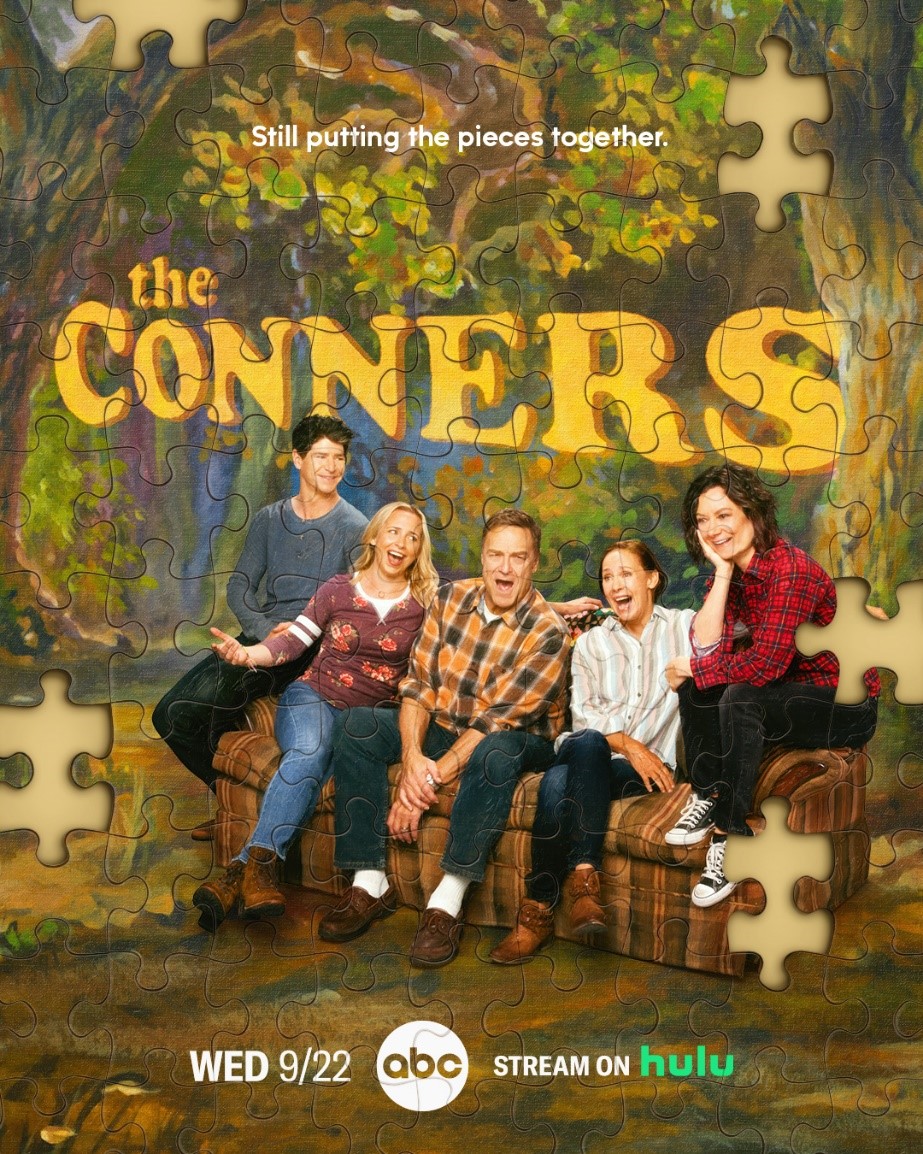
Today, ABC announced that for its season 4 premiere, The Conners will once again be airing a live episode.  But this time, there's an intriguing twist.

At the same time, the network also announced an innovative sweepstakes, titled "You Can Be a Conner."  Winners will receive a call from the cast -- on-air, as part of the episode.

Today at the Television Critics Association teleconference for critics, Executive Producer Bruce Helford referred to the gimmick as "working without a net," because the selected fans will not know what the topic of the episode and thus the call will be -- nor will the producers know what said fans will say, live on-air.  (One would imagine that ABC will be airing the whole thing on the standard 7-second delay, but still, I think the censor should start practicing hitting that button now.)

The episode will air on September 22 at 9 PM Eastern, and will be performed live for both the East and West coasts.  Enter at www.BeAConner.com, and see details below in ABC's press release.


LIGHTS, CAMERA, ACTION: ‘THE CONNERS’ IS GOING LIVE!


SEASON FOUR TO DEBUT WITH LIVE PREMIERE EPISODE

WEDNESDAY, SEPT. 22, ON ABC


‘YOU CAN BE A CONNER’ SWEEPSTAKES LAUNCHES TODAY

GIVING FANS A CHANCE TO WIN AN ON-AIR CALL DURING LIVE PREMIERE BROADCAST


conners.jpg

ABC’s No. 1 comedy last season is set to return with more laughs, surprise guests, a live episode and a chance for viewers to win a virtual appearance as a member of the Conner family in the season four premiere when “The Conners” returns WEDNESDAY, SEPT. 22 (9:00-9:31 p.m. EDT). 


The cast of “The Conners” will perform live for both the East and West Coast broadcasts of the season four premiere episode. The members of America’s favorite family are no strangers to live television, but this time, they’ll need some extra help to pull it off. Starting today, ABC and “The Conners” are launching the “You Can Be A Conner” sweepstakes, offering viewers the opportunity for a once-in-a-lifetime experience by entering for the chance to win a virtual appearance during the live season premiere episode. As part of the storyline, a Conner family member will call each lucky sweepstakes winner for a live conversation regarding how they deal with some of the same life issues that the Conners navigate on a daily basis.


The sweepstakes is open to legal U.S. residents, 18 and older. No purchase is necessary to enter; visit www.BeAConner.com for official rules and full details.


“The Conners” stars John Goodman as Dan Conner, Laurie Metcalf as Jackie Harris, Sara Gilbert as Darlene Conner, Lecy Goranson as Becky Conner-Healy, Michael Fishman as D.J. Conner, Emma Kenney as Harris Conner-Healy, Ames McNamara as Mark Conner-Healy, Jayden Rey as Mary Conner and Jay R. Ferguson as Ben. 


“The Conners” is executive produced by Tom Werner, along with Sara Gilbert, Bruce Helford, Dave Caplan, Bruce Rasmussen and Tony Hernandez. The series is from Werner Entertainment. 


Follow “The Conners” (#TheConners) on Instagram, Twitter and Facebook. 


ABC programming can also be viewed on demand and on Hulu. 

Saturday, April 10, 2021

A Tribute to Anne Beatts and her creation, Square Pegs

Back in the days when I was editing the “Icons” (classic TV) section of CBS’ Watch! magazine, I was like a kid in a candy store.  So many of the shows I had grown up adoring had been on CBS – and now, I had license to get in touch with any of those shows’ creators and/or stars, to write tributes of all my favorites, one by one.

In February of 2008, I was thrilled to get to interview Anne Beatts, to pay tribute to her 1982-83 sitcom Square Pegs, short-lived but influential on my generation of actors and writers – and everyone else adolescent at the time.  [I must admit, my writing partner Bonnie Datt and I were so molded by Square Pegs that we even wrote its characters into a spec script we wrote for Sex and the City – melding the two worlds and winning a few screenwriting awards in the process.]  The piece ran in the magazine’s May/June 2008 issue; you can check it out here: 

But Anne, who died this past Wednesday, April 7 at age 74, was way too interesting to be confined to a mere page’s worth of memories.  And so below, here is the full scope of her memories not only of creating the beloved sitcom which brought Sarah Jessica Parker to national attention, but also as a pioneering “girl writer” on Saturday Night Live.


The Square Pegs Origin Story

Square Pegs was autobiographical.  What happened was that I had been on Saturday Night Live for the first five years of that as a writer.  And then the upheaval happened.  Lorne Michaels was no longer doing the show.  Everybody left at one time.  And I had an agent, an older gentleman named Frank Cooper. He had been Frank Sinatra’s first agent – he was of that generation.  He was trying to get me some other work.  And he said, “I guess you were probably very popular when you were in high school.”  And I said, “Oh, Frank, are you kidding?  I wasn’t very popular at all!  I was a square peg when I was in high school!”  And he said, “Why don’t you write about that?”

Frank had the idea he could sell a high school show to CBS.  There wasn’t a show like that at the time.  I guess there had been Welcome Back, Kotter and Happy Days, but at the time there wasn’t a show of that nature.  And he knew that CBS was wanting to skew younger -- which was a little bit of an uphill battle.  So we went in, and I had never pitched a sitcom.  I had never written a sitcom, or spec script, or had anything to do with the word “sitcom” -- and it kind of stuck in my throat a little bit.

I went in to CBS and had thought out what my life had been like in high school, me and my best friend.  So Square Pegs was based on us; I was the Sarah Jessica Parker character, the skinny one with glasses, and she was the short one with braces.  I harkened back to us, when we were in Somers High School in the ‘60s, in Somers, New York.

I wasn’t a big sitcom watcher.  So in my concept, I harkened back to [the 1959-63 CBS sitcom The Many Loves of] Dobie Gillis.  That was a model of a high school show that I really liked.  And then when I went in to pitch, guess who was in the room?  Dobie Gillis!  Because Dwayne Hickman was an executive at CBS at this point.  So here I go in to have a meeting with Kim LeMasters who was the CBS development exec at the time, and in the room – the way there’s always 3 or 4 people in the room – was Dobie himself!  I thought at the time that this was either good or bad omen.  I guess it proved good.  Because there I was, talking how much I loved Dobie Gillis and how my show could be like that.  That was the pitch.

My agent had set up for us to meet at NBC the next day.  I was at the Chateau Marmont [hotel], getting dressed for the meeting, and the phone rang.  It was my agent and the executives from CBS.  They had some concerns and questions about the show.  And basically it was, what about sex, drugs and rock and roll?  This was 1981, I guess, because I was on SNL from ’75 to ’80. So this was the fall of ‘81. Were these girls having sex?  This was pre-Dawson’s Creek; you did not want the answer to be yes.  You wanted the answer to be no, because they wanted to do something that was basically an 8 o’clock show.  And I said no, that they weren’t– which was perfectly true.  I wasn’t telling them just what they wanted to hear, but what my vision of the show was.

[My main characters] aspired to those things, but were nowhere near reaching them.  And I quoted another archetype, another movie that was important for me, which was The World of Henry Orient.  About a little girl chasing Peter Sellers around New York -- which I later learned was actually based on the real experience of the author, with Oscar Levant, of all people.  The original book was written by Nunnally Johnson’s daughter [Nora], and she had had for some bizarre reason an insane crush on Oscar Levant, so that was why there was this concert pianist character, played by Sellers, who they were crazy in love with.

I said that’s sort of the level of sexuality these [Square Pegs] girls are operating on.  So the CBS executives got it, and they bought the show on the phone.  Sad to say, I never had the meeting with NBC, because that actually would have been a better network, probably.  Hindsight being 20/20, maybe that would have kept the show on the air longer, because they were still struggling.  It turned out it was actually one of Brandon Tartikoff’s favorite shows.  He tried to buy it as a summer replacement show, but they had already unfortunately syndicated it to USA, so that deal didn’t happen.

Cheers was on NBC, and they had lower ratings than we did that year.  But [Tartikoff] believed in that show, and kept it on the air.  Unfortunately we were on the “Tiffany Network,” and were messing with CBS’ ratings.  This in the day when there were only three networks.  We had a 23 share.  Now if you had a 23 share, you would be the queen of Hollywood.  More people saw Square Pegs than ever watched an episode of Everybody Loves Raymond, and Square Pegs was a flop.  That’s the ironic part about it!

We did special material for the Square Pegs DVD, which comes out on May 13 [2008], and I think it will do well, although that depends upon if they promote it or not.  But it might do quite well, because people who were fans might buy it now for their kids.  Because it’s been 25 years.  So I think maybe the people who were 13-year-old girls are moms now, and might say it’s great for their kids.  That’s what I’m hoping, anyway.  There could be potentially a new generation of fans.  There’s still a tremendous amount of web presence for the show, all these web sites and things like that, and places where you can download episode guides and songs.  There’s a tremendous amount of fan stuff that’s out there.


The Launch of SJP, and Her New Friend, Amy Linker

We tried to tie the DVD to coincide with the Sex and the City movie.  We were able to get Sarah Jessica Parker on all the extras – actually all the cast members, except Merritt Butrick, who died [in 1989] and Jon Caliri, who was unavailable.  [SJP] had done Annie, but as she herself has said, she was not the first Annie [on Broadway]; she was like Annie #3 in the production, and she wasn’t Andrea McArdle.  And so really, that had not launched her career; so yeah, we did kind of discover her.  The person who was really responsible for that was Eve Brandstein -- she was the casting director for Norman Lear -- who also could be credited for discovering George Clooney and so many others.  She put a lot of people on shows.

When I finally wrote the pilot script – it was kind of amazing because it was the first sitcom ever I had anything to do with – I wrote the script, rewrote the script, it went to pilot, and then series.  I was like “Oh, I think I’ll do this [for a living.]”  Little did I know, it was like getting struck by lightning to get that to happen.

When the show was going to go to pilot, every production company in Hollywood was sniffing around, because I had this deal and a show for which I’d just written the script completely on my own.  So I was the most popular person in Hollywood at that point.  People were sending me flowers and champagne – it was amazing.  On the strength of Mary Kay Place’s recommendation, I went with Norman’s company.  She said “If you want to have your creative vision serviced…”  That’s how Eve and I first met.  Eve and Kim Friedman, who directed the pilot, and I went on a cross-country mission to find kids for this show.  And one of the big things about Tandem, as Norman’s company was called then, was that they were willing to cast age appropriately.  Because everybody else wanted [actors] over 18.  Like in 90210; they didn’t want the trouble of working with actual, real kids.  And so that was another reason that really sold me on [Tandem] as a production company, because they did work with kids.  With The Facts of Life and so on, they were accustomed to it, and would cast age appropriately.

Sarah Jessica Parker was the first person that I ever saw for the role of Patty.  Eve brought her in.  We were in New York, and she read, and Eve was like, “Isn’t she great!”  And I was like “Yes… but she’s too pretty.” Eve had a pair of sunglasses, knocked out the lenses, and put them on her, and said, “Now have her read.”  I still wasn’t convinced.  We made her come back like 8 times to audition.  You know how it is – do you take the first apartment you see?

Obviously she was the best person -- and with the Lauren character, we had similar issues because we were meeting these chubby girls.  And we knew we could put on fake braces.  But we were still reading girls who were chunky, and couldn’t find anybody.  Then I had the idea that we could put her in a fat suit.  Because I remembered when we were doing the bees on SNL, and we had these little padded body suits for the bee characters.  In 1982, the whole thing of prosthetics wasn’t nearly as advanced as now.  But still I thought, “Why can’t we do that?”  So poor Amy Linker had to wear fake braces and body padding and still deliver a performance.  Sarah had, of course, fake glasses, and as she said, she had to dress as an Appalachian child.  She got her revenge for that later!


Casting the Cool Kids

Literally, we went everywhere.  San Francisco, Atlanta, Boston, Chicago.  Jami Gertz was in Chicago, and she had kind of done local commercials.  Nothing really.  And Tracy Nelson was a funny thing, because she said to me when she auditioned, “You worked with my father.”  I was like “What?” and it turned out her dad was Ricky Nelson, who had been a host on SNL.  Which made me feel a lot older suddenly.  I got a few gray hairs there, I think.

So we did really do the Gone With the Wind talent search to get these people, the embodiment of the characters as I saw them.  One reason the show worked so well, I have to credit the casting.  John Huston used to say casting was everything, and I really have to say that it is.


A Slice of Real Life

I think [all the characters] were high school archetypes.  That may have changed, but I suspect not all that much.  There’s the student leader like Muffy, the king and queen like Vinnie and Jennifer.  And then Jennifer had to have a friend and confidante, and I really wanted to have the show be multiracial, so it was logical to me to have an African American girl [played by Claudette Wells].  Which also was groundbreaking; not since I, Spy had there been black and white friends.  And this was 1982!  So that was important to me that there be a person of color in the show.  As there had been back where I was; Somers was a predominantly white bedroom suburb, but there were Black kids in the school.

My friend does know that Lauren was based on her – and I think she’s flattered.  I had saved all the notes we wrote to each other when I was in high school.  The one issue was whether the show needed to be period or not, like The Wonder Years, which came later.  I really wanted it to be contemporary, because I wanted to be able to do jokes about Reagan and things like that, and be “of today.”  So I borrowed the daughter of a friend of mine and her friend, who were 14-year-old girls who went to private school in Manhattan, and lived in Soho.  So I thought of them as reasonably sophisticated.  I wanted to check that I wasn’t totally off.  I remember, I took them to lunch and said, “Is there anyone in your school who is doing this?”  And they said “Oh no, only the sluts!”  And I thought, “God, things have not changed.”

And then I asked them, “Who are your heroes?” and they said Che Guevara – they didn’t really know who he was but had a poster – and James Dean.  And then I was like “Okay, I can still write this.”  But then I tried to keep my ears open to current slang, and that’s how the Jennifer Valley Girl character came about.  And that was before the song “Valley Girl;” even though the show was on the air after the Moon Zappa song came out, we had shot the pilot before that.  That was something Tracy came up with.  I remember Tracy said – she was not conventionally the pretty girl -- that she was auditioning with all these girls more conventionally gorgeous.  And they were like, “You’re not here for the Jennifer character!”  They were mean to her.  And so she figured “I’m going to get this” – this fierce resolve.  Here were the girls who had been mean to her in high school!  She ended up doing a devastating take on people she had observed.


 The Music of Square Pegs

The music was another thing that was groundbreaking – this was pre-Miami Vice.  There really hadn’t been rock and roll on TV since Ricky Nelson.  It was very important to me that the music be part of their world.  Johnny Slash, the anomalous character, was the way the music came into the show.  If you want to talk archetypes, there’s always the strange kid.  And he said he was “left back and laid back.”  It’s like that line in Animal House:  “Six years of college down the drain.”

I was listening to the radio, and I was going to clubs in New York, and was hearing these [New Wave] groups.  What was interesting about The Waitresses -- my friend Lynn Goldsmith is a rock and roll photographer who just put a book out.  She had taken shots of all these iconic people, like Springsteen.  She was someone I turned to for music world connections.  She told me about The Waitresses, “the perfect group for your show.”  I was like “Okay, the Waitresses.”  And then [coincidentally] I was listening to a song on the radio, “I Know What Boys Like” – [and thought] “this is the perfect group for my show!”  I said, “I don’t know about the Waitresses, but I want the group who did this song!”  So we got them, brought them out [to L.A.] to be in the pilot, and also to write the theme song. 

When they had Square Pegs on Nick at Nite at one point, they had a sequence which thrilled me, where they had people in the street, singing theme songs -- and they had people singing the Square Pegs theme song.  So I was pretty pleased.  I worked with them [in writing] it – glasses, and cliques, and so on.  I was telling them what it should deal with.

Once we did the pilot, and then it was picked up by CBS, which was also quite an amazing thing, the market research for it was not good.  It said things like “These kids should be in an insane asylum, not a high school.  They’re disrespectful of adults.”  Cleverly, Kim LeMasters kept it under his hat, because luckily for me, he had been promoted up the ranks as the show had moved along, and had more power, and was a big proponent of the show.  And ultimately [CBS senior programs executive] Harvey Shephard also became very fond of it.  His daughter, Greer Shephard, went on to produce such shows as Popular, and was a big fan of the show.

At one point, for Muffy’s bat mitzvah, it had originally been booked to be The Clash, and they fell through.  And funny, to think that The Clash was going to be on Square Pegs.  When they fell through, we had the Boomtown Rats begging to be on the show.  They sent us a side of smoked salmon.  Meanwhile, Devo was also another possibility, and they were local.  So I had to call up CBS and ask them which.  Harvey called his daughter Greer and asked her – she was in high school at the time – and she picked Devo.  So Devo was on the show.  And then they tried to cancel, and I couldn’t find out why they were cancelling; and it turned out the head Devo guy had scheduled root canal for the same week.  I remember being on the phone with him saying, “Change your appointment – you have a contract!”


Square Pegs on the Air

When the pilot got picked up, I had to hire a writing staff.  That was another struggle, because I remember they made me hire Andy Borowitz.  They didn’t want to have a staff composed entirely of women.  I wanted women because I was writing about girls in high school, so it seemed the writers should be women.  So the staff was women, and Andy.  He was our token male.  We used to call him Tootsie Borowitz. 

M*A*S*H was the only other single-camera show on the air at the time.  Our [Director of Photography] was a guy who had worked on M*A*S*H.  He was about 70 or something.  Emil Oster.  People were not shooting single-cam because it is more expensive; but now, everything is single camera.  Obviously there will always be multi cam shows, because comedians like to perform in front of a live audience.  I teach sitcom at USC – I work for the writing division of the School of Cinema and Television, now called the School of Cinematic Arts because George Lucas gave them a bunch of money.  I’m an adjunct professor.  And almost all the shows I’m teaching are single-camera.  Entourage, Weeds, even Scrubs or 30 Rock.  So that was another issue.  And that was another reason why – when I was in this bidding war where people were wining and dining me and wanting me to pick their production company – one of the stipulations I had had was that I wanted the show to be single cam.

I had worked on commercial parodies on SNL and actual commercials in England, which is where I had first worked in TV: 30 millimeter film, sixty-second black-and-white TV commercials in the ‘60s in London.  So it was very important to me to do [Square Pegs] in single camera, because for me it was a reality element.  I felt it should be [shot] in a real high school.  And it was shot in a real, abandoned high school, in Norwalk, California.  It had been condemned for heating problems.  It was the school where they had shot Grease 2. 

The show was supposed to be set in upstate New York, outside of New York City – a la Somers.  But it was odd, because there ended up being a Valley Girl on the east coast – because she was a transfer student.  The reason we shot it in Norwalk was to find a school that looked like one of those WGA school buildings they built during the Depression on the East Coast.  There wasn’t that kind of school in Beverly Hills.  And so the exterior shot was actually a middle school that’s over on McCadden place in Hollywood, and the interiors were all at the school in Norwalk, which was great; we would never have been able to build those sets.  We had the full cafeteria, and an auditorium and theater – it was an amazing physical plant.

What was very lucky was there was a football strike.  Football was on another network, ABC, but it was lucky for us in terms of our competition.  We were on opposite Little House on the Prairie on NBC, so that was the real ratings competition, because obviously it was a similar audience.  I never wrote the show to be a kids’ show.  I didn’t realize that, that they would say “Is it an 8 o’clock show or a 10 o’clock show?”  To me it was a show.  It was meant to be for everybody.  It was sort of ghettoized by CBS in a way I never intended to happen.

[Mondays at 8PM] wasn’t a great night or a great time slot.  But because of the football strike, we were protected for a while.  Then they moved us to Wednesdays at 8:30, and that was the death of the show.  They said “We have great new show to give you as a lead in:  Zorro and Son.”  There wasn’t a lot of competition, but in a counter-programming move, NBC moved The A-Team up to 8 o’clock, and that was the end.  Suddenly we got a 12 share – still not so shabby in today’s terms, but then it was death.  I was in New York and called up to get the overnights, and the girl told me 12, and I knew pretty much that it was over.  And then she asked me for a job, and I wanted to go, “With timing like that, stay out of comedy.”

We got cancelled after 20 episodes.  It would have been nice to get 22 or 24, but we had 20.  We had a lot of support from the network.  We had a lot of support from CBS, but not from the production company.  That show was expensive for them, and the guy who was running it, who later went back to England, just never got the show and didn’t support it.  He actually left the company after that year, because he also had allowed them to cancel Archie Bunker’s Place on his watch, and it wasn’t taken very well.  

We were on at 8, so we were trying to start the night.  We didn’t have a hammock, a lead-in.  The only lead-in we ever got was Zorro and Son, and of course that was famous [as a disaster, lasting just five episodes].  The thing about it is that if right now, you had a show that every 13- to 16-year-old girl was watching, you’d have Gossip Girl.  And you’d be a big hit. 

But here's the big difference between our show and other teen shows, like Our So-Called Life.  Our show was a comedy.  And I think that is a big difference.  If the show had been kept on the air, it had the potential to be more successful than drippy shows about teenage angst.  Our show was based on the premise that someday you'll look back on all this and laugh.

Wednesday, August 19, 2020

The Kids Are More Than All Right -- and you have a second chance to see them

F
or as much success as ABC has had in launching comedies that introduced us to American families of different ethnicities -- black-ish, The Goldbergs, and Fresh Off the Boat, as the most prominent examples -- the network has for some reason been unable, or more likely too impatient, to make a success out of a sitcom featuring an Irish-American clan.

In 2016, ABC launched the very funny The Real O'Neals, about a modern day Irish-Catholic family with a gay son -- but cancelled the whole enterprise after just two abbreviated seasons and 29 episodes.

Then in 2018 came The Kids Are Alright, an, I daresay, even better, funnier comedy, about the exploits of the gaggle of eight Cleary brothers and their comically world-weary parents (Mary McCormack and Michael Cudlitz) in the turbulent 1970s. One needn't be Irish-American like me to appreciate the warmth and authenticity of this truly laugh-out-loud show -- plus, isn't everyone Irish at least that one day a year in March? -- but ABC clearly didn't see it that way.  In one of the network's more shocking, short-sighted cancellations of late (although remember, they also prematurely cancelled The Real O'Neals, Better Off Ted and Happy Endings, so should we be surprised, really?), the Cleary Kids lasted just one season.

I'm sure no one was as disappointed as the show's creator, Tim Doyle, and not just for the usual workaday reasons, but because The Kids Are Alright was based on his own upbringing, as the artistic child with acting aspirations amid a writhing horde of brothers.  Doyle, whose credits include beloved shows like Better Off Ted and Ellen, on which he served as executive producer, used his acting background to provide the voiceover narration for the show, which faithfully retold many of his own hilariously humiliating life stories.

But now, in a streaming world, is any sitcom family truly dead?  Just recently, all twenty-three episodes of The Kids Are Alright popped up on Hulu, which is both a joy and relief to me, because now I can safely delete them from the valuable real estate on my DVR.  In celebration of the Clearys' return, I asked Tim six questions -- I should have made it eight, one for each Cleary kid -- about why we should watch.


Must-Hear TV:  How did the show end up getting on Hulu?

Tim Doyle:  During the initial run, Disney made each episode available after airing on the abc.com website and Hulu. But after we didn’t get our season two order, it was quickly pulled down from both — which seemed weird. I didn’t understand their hurry to make us unavailable. Other canceled ABC shows were still being offered. Hell, there are canceled shows which I wrote back in the ‘90s still running on those sites. My first TV job, Jim Henson’s Dinosaurs, is coming back to Disney+ in a couple of weeks!

Fans of The Kids Are Alright kept contacting me on social media, complaining they couldn’t watch those original 23 episodes — nothing on any streaming service, no DVD release. What gives? Then when the quarantine descended, it just struck me as wasteful, like the company was missing a bet to give folks something they might enjoy bingeing during these crazy times, and maybe even build a new audience who didn’t find the show during its network run.

When fans reached out, I basically started encouraging them to write to Disney Channel, Disney+, ABC, Hulu — the various platforms Disney now owns. These fans are passionate. I think they even sent a few pleading letters to Nat Geo! And suddenly I got a nice email from Peter Rice, the CEO of Walt Disney Television, telling me that Kids would go back up on Hulu starting August 5. No idea what their internal process was, but I have to assume that viewer enthusiasm must have played a role.


MHTV:  How do you feel about the show being back and available for viewers to discover?

TD:  I obviously think it’s great. You make these shows to be seen, and I’m afraid Kids never really got the launch it deserved. Any interest in our premiere got massively overshadowed by the huge scandal in the fall of 2018 surrounding Roseanne getting herself fired from our lead-in show, The Conners.

The press pretty much ignored our premiere, when they weren’t being preemptively dismissive as they often are with new network offerings. The glib wisdom regarding us was that we were just a ‘70s version of The Goldbergs — which nobody who watched a single episode would ever actually say. I must have read ten versions of the same smarty-pants “Goldberg Variations” joke among the quippy quick hot takes folks who write for the short attention span media.

It was gratifying, however, when more serious TV columnists weighed in and we got almost universal praise, I assume because they actually took the time to watch the episodes. We received an extremely high rating on Rotten Tomatoes as well, and the pilot script earned a WGA nomination for best writing of a comedy episode. I felt confident that if we made past summer we could easily pick up a few Emmy nods — at least Mary McCormack, Michael Cudlitz and our art department. With that encouragement the cast and crew worked insanely hard and delivered a consistently strong first series of 23 episodes. The show did well but was never quite a ratings hit, struggling to break through all the media clutter. So now I feel like there’s got to be a massive captive audience out there who can discover and love this show if we can only help them find it on Hulu.


MHTV:  What to you is so personal about the Clearys that you want to share with the audience?


The Kids Are Alright creator
Tim Doyle with his TV alter ego,
Jack Gore, at PaleyFest,
September 8, 2018.
TD:  Well, it really is based upon my childhood, my family, my parents -- so writing it was the most gratifying and fascinating creative act I have ever experienced, a true act of confession — of saying things I’ve always wanted to say about being a brother, being a parent, being a son, being a Catholic, being lower middle class, and living through that very confusing decade of the 1970s. For thirty years I’ve been writing other people’s TV shows, telling my own stories only through that distorted, veiled lens. By contrast Kids was so pure and gratifying. No, it’s not a documentary. A lot of things had to be changed from my real life for technical reasons, for legal reasons, or for comedy, but... I can now say to my daughter, or some grandchild down the road... to anybody interested, really: If you want to know who I am, watch the show. It’s all in there. I got that rare opportunity in an artist’s life to cut straight down to the bone and give you my DNA. And a major corporation paid for it all!  


MHTV:  What parallels are there between the time period the Clearys live in versus where we are now?

TD:  The anger in the public discourse was very similar to now, the social and political divide. I think now is worse, but only by a bit. In 1972 some of our beloved national leaders had recently been ASSASSINATED, and we watched it happen on live TV — as disorienting, scary and surreal as witnessing 9-11.

The Vietnam War had us divided. Nixon had us divided. Like today everyone was on a hair trigger of rage, exhilaration and frustration as we watched violent street protest and a presidency falling apart. Would our republic even survive? These are real questions we worried over then and are definitely revisiting today.

My father had terrible politics. But I loved and respected him. I loved my mom as well but she was suppressed and oppressed by the times, never becoming the fully realized person she certainly should have been. And watching the two of them struggle and puzzle through those turbulent years where everything they valued was suddenly up for grabs gave me the perspective to become — for good and for bad — the person and the artist I am today. 


MHTV:  Were you surprised the show didn't get picked up for season 2?  What were your plans for the family and their further experiences?

TD:  There were a number of warning signs along the way, but I was still absolutely flabbergasted with disbelief when ABC chose not to order a second season. In my mind — and I think there’s an objective case to be made for it — we were the BEST comedy on their schedule, CERTAINLY better than several of the shows with LOWER or absolutely comparable ratings which they chose to renew instead. I could not believe the choices they made.

I remember telling Karey Burke that she must possess a high threshold for embarrassment to keep several of the shitty shows she did and toss mine in a dumpster. (BTW this lack of diplomacy with my bosses might also have been a factor in getting my show canned.) In retrospect, our status on the network became much less secure as soon as Channing Dungey and Jamilla Hunter left ABC in December 2018, and were replaced by Dana Walden and Karey. A new creative team coming in always wants to prove itself with a sharp change of direction, and Kids was a leftover project of Channing’s. She had been our champion. Suddenly ABC was giving us fewer on-air promotions, our strong lead-in The Conners went away, and we found ourselves pre-empted to try out new shows in our time-slot. I should have seen the writing but I still naively thought that our superior quality would win the day.

In terms of season 2 and beyond, I have notebooks full of scribbled notions, things we just never got to in the first 23. And more stuff pops up every day — a glance at an old family album or seeing a retro commercial on the internet will send me instantly right back to 1972. The great thing about a series which comes out of your life is the deep story resources immediately at your disposal. Someone in the writers’ room asks, “Did Frank ever have a girlfriend?” or “Did your mom ever work outside the home?” or “Did Joey ever get in serious trouble with the law?” and you’re off to the races with memories of the funny, painful, real stories a family like mine experienced. I would LOVE to get to the REALLY GOOD stuff:  Timmy’s adolescence under Joey’s Bob Guccione-style tutelage and the tug-of-war I went through for years (am still going through?) between sex and my more childish passions, like magic, musical theater and puppetry!


MHTV:  Is there any chance, particularly if the show does well on Hulu, that it could come back?  And if it does, will you please change the spelling to "All Right?!" 

TD:  There’s always a chance. Just a year or two ago I would have scoffed. Dead is dead. Once a show has the stink of rejection on it no platform is going to risk the shame of associating itself with a proven failure.

But I can’t argue with the passion of our fans. They keep asking me for more — an animated cartoon, a comic book, a novel, a Halloween or a Christmas special. You have to think “never say never” these days. There is just sooooooo much TV and so so so many players with such a voracious appetite for content. Yes, I’ve moved on to other projects but I’m still scribbling in my notebooks ideas which I’d love to do on some future iteration of The Kids Are Alright. So wherever I end up next with my new series ideas — cable, streaming, network, Google Maps, the little TV built onto the gas pumps — if I find any further measure of TV success I’ll be looking to leverage that success into a revival of Kids taking place perhaps in 1974, 1975, 1976, 1977, reuniting that amazing cast and telling more stories from deep vault of my remarkable but also highly-typical American family. 

And yes, I’d be happy to change the “alright.” 

Friday, July 26, 2019

The Ladies of Sugarbakers Ride Again

The cast of CBS' original Designing Women (1986-93):
l-r: Annie Potts, Jean Smart, Meshach Taylor,
 Delta Burke, Dixie Carter
This morning, at the Television Critics Association convention in Beverly Hills, Hulu made one of the most exciting announcements of the press tour so far -- about a show that premiered nearly 33 years ago.

After finding huge success in streaming all seven seasons of The Golden Girls, Hulu has announced its acquisition of all seven seasons -- 163 episodes worth -- of the 1986-93 CBS hit sitcom Designing Women.  The series will be available beginning August 26, which not so coincidentally, happens also to be Women's Equality Day.

Following a similar comedic "rule of four" with its characters, Designing Women starred Dixie Carter, Delta Burke, Annie Potts and Jean Smart as four women of different backgrounds and certainly personality types who ran a successful design firm in Atlanta, with Meshach Taylor joining as a fifth partner in the Sugarbaker Firm.  In many ways a Southern Golden Girls, Designing Women dared tackle political topics and social issues of its day even more directly -- in fact, it was the first sitcom to air an episode dealing with the HIV/AIDS pandemic -- and has earned a similarly devoted following even more than three decades later.  In fact, it's hard to find a gay man of a certain age who can't quote Julia Sugarbaker's "The Night The Lights Went Out In Georgia" rant word for word, after seeing the video clip playing seemingly on a loop in American gay bars.

With reboot fever in full bloom, Designing Women's prolific creator, Linda Bloodworth-Thomason, had recently written a pilot script which would feature a brand new generation working at Sugarbaker's -- but they would also be graced by recurring, if not regular, visits from the show's three original stars, Burke, Potts and Smart.  At a press event for Potts' current series, CBS' Young Sheldon, in the spring of 2018, she expressed enthusiasm for appearing again as Mary Jo Shively in any new Designing Women; but unfortunately, this past winter of 2019, ABC declined to shoot a pilot for the series.

It's not a complete coincidence that after Hulu began streaming The Golden Girls that Disney/ABC, the show's rights owner, finally began creating merchandise such as tee shirts, action figures, themed Monopoly and Clue games, and so much more.  (Immodestly, I must say that part of the credit should also go to my book Golden Girls Forever, which alerted Disney about all the merch money they had long been leaving on the table.)

So perhaps, with the new heat coming from Hulu, Designing Women might ride again?

Thursday, March 22, 2018

Designing Women Reboot? If so, Annie Potts Wants In

PaleyFest's Young Sheldon panelists:
(back, l-r) creators Chuck Lorre and
Steve Molaro, moderator Jessica Radloff,
stars Montana Jordan, Annie Potts,
Zoe Perry, Lance Barber and
Jim Parsons, and (front)
Iain Armitage and Raegan Revord
March 21, 2018, The Dolby Theater, Hollywood
Photo by Michael Bulbenko for the Paley Center
Last night at Hollywood's Dolby Theater, the 35th Annual PaleyFest presented two related panels, featuring the creators and stars of both the 11th season sitcom megahit The Big Bang Theory, and its freshman prequel Young Sheldon, which in its debut season ranks as the top new show on TV.

As Young Sheldon stars Iain Armitage, Raegan Revord, Montana Jordan, Zoe Perry, Lance Barber and Jim Parsons also walked the blue carpet prior to the panel (expertly hosted by Glamour's Jessica Radloff), I was most excited to talk with Annie Potts, who of course had already portrayed one of the protypical Southern women on TV on the '80s-'90s CBS sitcom Designing Women, and now was playing a slightly older model as Memaw on Young Sheldon.

Ironically, Young Sheldon is set in the late '80s, when Designing Women was one of the sitcoms ruling CBS' airwaves.  During the panel, the cast was even asked if Raegan's character Missy, always parked in front of the TV, might end up watching Designing Women, but the show's creators, Steve Molaro and Chuck Lorre, and particularly Annie, think that might be too bizarre.

But clearly, with the return of Will & Grace and the impending returns of Roseanne and CBS' own Murphy Brown, the idea of somehow rebooting Designing Women is in the air.  In fact, when I asked Annie if she had any interest in a Designing Women reboot, she noted that someone earlier on the carpet had already asked the same thing. 

So, would Annie like to juggle her current role as Memaw with a reprise of her beloved Mary Jo Shively?  "Yes, I would," the actress immediately answered.  "I'd love to!  I don't know when I'd do it, but if Linda Bloodworth[-Thomason] wanted to write six episodes or something, that could be done during a hiatus period, yeah, I'd do that!  Because I think it's important. Those were strong characters, and we got to say stuff that women haven't been able to say since. I mean, we took on Donald Trump long ago!  We were speaking truth to power."

Sunday, July 16, 2017

Hot Pants in Hollywood

From her first TV job on Laugh-In, to her pioneering work as a writer on The Mary Tyler Moore Show, The Bob Newhart Show, Square Pegs and other sitcoms, Susan Silver has had an amazing career.  And as a woman growing up in the formative decades of the conservative '50s and free-swinging '60s, she's had a fascinating life as well.  And now it's all in her new book, Hot Pants in Hollywood:  Sex, Secrets & Sitcoms.

The title is derived from that of an article TV Guide magazine wrote about her back in the day, which they called "The Writer Wore Hot Pants."  It's telling that apparently the concepts of being female and being a writer were considered as incongruous back then as were the title subjects of another '70s vehicle, The Computer Wore Tennis Shoes.

After devouring Silver's memoir, I asked her more specifically about her days as a woman "making it on her own," to quote MTM's theme, in Hollywood.


Must-Hear TV:  How did your traditional Midwestern family background prepare you -- or not prepare you -- for life in Hollywood?  How did it prepare you to write for a character such as Mary Richards?

Susan Silver:  Coming from Milwaukee, which is often confused with Minneapolis, I was perfect for The Mary Tyler Moore Show -- though frankly I'm much more Rhoda than Mary.  I have too much spunk!   Seriously I think the difference in values is huge, and I'm glad I had the basics from the Midwest.  Hollywood is a place unto itself.  I used to say I had to leave because my tush fell and they measure it when you get off the plane.  It's very superficial still, sorry to say.  So I arrived like Little Annie Fanny, wide-eyed.  But it was easier than New York, which would have chewed me up and spit me out.  For that, I had to wait until after some success. 


MHTV:  At the time of the MTM Show, there were few or no female comedy writers working on sitcoms.  What do you think made the MTM producers decide they needed a female perspective?

SS:  The great timing of the show, with the beginning of feminism, was an impetus to get a woman's POV.  Rarely heard before, real women's lives were what the show wanted and they thought we were all geniuses.  The truth was, all women have the same stories to share and they had not been heard before.  By the end of the show I think 25 women had been hired as writers.


MHTV:  What were some of the most common pitfalls a comedy writer would face in decades past in her career?  What did you learn to do or not to do from your own career?

SS:  I feel as though I started on top, and so my requirement and what I had learned was to pick only high quality shows.  Most of us don't have that luxury.  On MTM [company] shows they worked with you all day, but on other shows they would give you a 20-minute story meeting and you had no real idea what they wanted.  Nor did they, so there was more rewriting.


MHTV:  Hollywood is a ridiculously ageist town.  Would you still want to create your own show?  And if so, what would it be, and what message would you/it be trying to say?


SS:  Ageism is the new discrimination. The Writers Guild had a longtime lawsuit against studios, which we won, and it was proven that there was so much of it... and it still exists. I doubt that writers over 50 have a chance.  The sad thing is that great shows like The Golden Girls, as you know, have audiences, if only they would write them and put them on.   I don't think I'd want to be active in the biz now unless I had total control, and wouldn't write a show where Boomers were portrayed so unrealistically or as sex-starved cliches.  But what the hell -- if someone wants me to do a show, call me.  George Clooney can call me, too.  I know he is a new father but still...

Wednesday, June 7, 2017

Behind the Scenes with Downward Dog's Title Character

Ordinarily, summer is a tough time for a network show to have its premiere; we the audience have been conditioned to tune out after May's season finales, and we spend more precious primetime hours still outdoors, enjoying the longer evenings of summer.

But Downward Dog seems to have timing on its side.  The show premiered on May 17, in a plum position following the season finale of Modern Family.  And of course Downward Dog, starring Fargo's Allison Tolman as single, dog-loving Pittsburgh creative executive Nan, follows in the wake of this year's earlier hit film, A Dog's Purpose.

Downward Dog co-creator Samm Hodges
and star Allison Tolman
In May of 2016, when ABC announced the show's pickup, it was unfortunately in the same breath as another show announced for midseason, Imaginary Mary.  And so the two shows became lumped together in the minds of critics, who thought ABC must be desperate to pick up shows about an imaginary friend and a talking dog.

Smartly, though, Downward Dog soon distinguished itself from the pack.  In January, the show, which is based upon a popular web series of the same name, became the first broadcast TV series to premiere at the prestigious Sundance Film Festival, to positive reviews from the audience and critics.  And the ratings for the show's premiere were respectable, with a decent retention of Modern Family's audience, even though it aired against another big hit, Fox's Empire.

As of last night, ABC has now aired four of the series' eight episodes -- and word is, the network will be making a decision about cancellation/renewal any minute now.  My dog Gabby and I love the show.  And while she's got her paws crossed for season two, I spoke with the web series and show's co-creator, Samm Hodges, who also provides the voice of its irresistable canine star, Martin.

An erstwhile commercial director, Hodges says he and colleague Michael Killen originally created Downward Dog just so as to have a creative outlet not beholden to any client.  But as I also found out when I spoke with Samm, there's another interesting angle to this story, about how becoming the voice of a TV dog has helped not just his bank account, but his personal growth as well.

Downward Dog co-creator Samm Hodges
provides the voice of top dog, Martin

Must-Hear TV:  Downward Dog certainly has had an interesting path to the small screen, as it caught the eye of some Hollywood managers and evolved from your web series into a half-hour show.  But the other aspect I don't feel the press has covered at all is that here you are, voicing the lead character -- and as you mentioned earlier, you grew up with a stutter.  How has that affected how you feel about voicing a character for TV?

Samm Hodges:  I grew up with a stammer, and there are things about the way I speak -- whether it be stuttering or the fast-paced delivery and other techniques I learned to get through it -- that now are helping to make Martin's voice feel unique and special.  There are other things I can do to help, like tailoring the lines to match my speech pattern in way that won't give me trouble.  Plus, if a stutter does slip into a take, sometimes rather than retake the line we might decide to use it.  In the end, we just want to have a character that sounds natural, and hopefully the voice actor disappears anyway.  I think people are going to watch the dog, and I hope they don't think about me ever.


MHTV:  Do you find it challenging or difficult to perform the role?

SH:  I think a lot of the show is about owning your flaws, and looking at your flaws.  And for me, doing the voiceover with a stutter, I get really frustrated.  I’ll always dread it.  My wife always knows the day before I have to record, because I might be an asshole that day.  It's very hard.  If you've ever had a really bad speech impediment, you know you're never really over it.  I know it will always be with me, and yet I'll get past it.  But then when I do go do the voiceover, I end up also realizing that it makes the show feel really authentic for me.  Our whole show is about characters who are vulnerable, afraid to be made fun of, and not being the polished star.  We’re all kind of outsiders, and now we the producers of Downward Dog are part of this punk rock TV show on a network.  A while back, I had wanted to recast mysef, but then I realized that even though performing the role was a pain for me, it actually gave something to the show.  So I realized I’ll do it for the show.


MHTV:  Your voice has a laconic quality that really helps give Martin a fun personality.  You really should be doing voiceover for a career.  You must find that odd to hear someone say that to you in 2017, because there was probably a time as a child where you beat yourself up for your voice.

SH:  It’s crazy.  The thing is, whenever you’re told what you can’t do, it kind of makes you want to do it.  I think as a writer, I write from a place of trying to be really radically honest.  And the show is really radically honest.  And I feel that if I ask my actors to be vulnerable, then I have to step up and be vulnerable myself.  Martin provides me a way to make fun of all my worst qualities.  If Martin thinks he’s smart, I think I’m smart.  When you put that in a dog’s mouth, it reveals how silly we are.  We in the entertainment industry tend to be narcissists, and I’m a narcissist.  So I always thought I was special. And for me, being a dog who thinks he’s special is a way to admit how messed up I am, but also how I’m still a worthwhile person, 


MHTV:  What kind of work did you do to overcome the stutter the way you have?

SH:  It’s funny.  I was raised really poor.  I never had any speech therapist offered to me.


MHTV:  I had speech therapy in elementary school, and I know how hard the work can be.  That’s impressive!

SH:  I was a senior in high school and couldn’t really speak well.  I got so frustrated that my dad’s friend, who was an undergraduate for speech therapy, gave me a worksheet.  I would just read it out loud to myself.  I worked really hard at it.  There had been times in a McDonalds where they’d think I was mentally handicapped.  It was really embarrassing, but that ended up giving me a lot of confidence and makes me hard to embarrass now.  So if I’m pitching, I don’t get scared because I’ve lived through so much embarrassment.  It’s weird in life how things work out that way.


MHTV:  Where were you raised?

SH:  In Washington state.  In a cabin off the grid.  No electricity, no running water.  Really weird.  My mom passed when I was young.  Not a happy childhood.


MHTV:  I hope you give yourself a lot of credit for learning from a worksheet.  It’s hard when you have someone working with you, and you did it yourself from a piece of paper.

SH:  As a poor kid from a poor town with a stutter, I felt like I was doomed.  I felt like there was no way out. Then in high school, I was part of a mock trial.  I chose to be the lawyer, which is insane.  And I actually won the mock trial and got all these awards.  I decided I wasn't going to stop fighting.  It’s the kind of thing where someone tells you “You’re not going to make it.”  It’s such a motivator.  If I go back home now, most of my friends are still stuck there.  And the meth use is really tragic in small towns now.  I was lucky.  I think I worked really hard, but I was really lucky.


MHTV:  [Downward Dog executive producer] Kat Likkel has encouraged you to get a voiceover agent and career.  Would you want to pursue that?


SH:  I would, totally.  I’m a small-town kid.  I like working.  But it’s the last thing I ever imagined myself doing.  It’s kind of happened naturally, and that’s the weird way life works sometimes.  I would never have thought this would be where I’d be.

Monday, May 29, 2017

How Speechless Will Continue Giving Voice to Families with Special Needs

On May 17, ABC's family comedy Speechless finished a flawless first season, with a finale episode in which the DiMeo family flew across the country to deliver son JJ to camp.

ABC's Speechless stars, l-r:
John Ross Bowie, Mason Cook, Micah Fowler,
Kyla Kenedy, Cedric Yarbrough and Minnie Driver
at the Paley Center for Media, Beverly Hills
May 9, 2017
It was a great moment for each character:  for Micah Fowler's JJ, who gets to taste a first bit of independence; for siblings Ray and Dylan (Mason Cook and Kyla Kenedy) who experience their own firsts along the route; and for John Ross Bowie's Jimmy and particularly Minnie Driver's Maya, who learn they're going to have to start letting go of the disabled child they've protected all his life.

And as beautiful a bookend as this 23rd episode -- ABC likes the show so much that back in December, they ordered one extra installment for this first season -- was for the family we had come to care about, JJ's ability to survive summer camp certainly doesn't signal that the struggle is over.

Last month, on the eve of its upfront presentation, ABC officially renewed Speechless for a second season.  Just days before the official order, which everyone had anticipated, I attended an event celebrating the series at the Paley Center for Media in Beverly Hills, and caught up with the show's creator, Scott Silveri -- upon whose own family the DiMeos are loosely modeled -- to talk about what we can expect for season 2 and beyond.


Must-Hear TV:  So what have you thought about for season 2?  There obviously must be some family stories with which you probably frontloaded the series in season 1.  But are there still more personal stories you want to tell?

Speechless creator and Executive Producer,
Scott Silveri
Scott Silveri:  Yes, that’s the way to characterize it.  In the first season, you have to really concentrate on those dynamics between the [main characters] who are in the show every week.  And in the second season, hopefully people are familiar with them, and we can open it up a little more.  We can learn a little about where Minnie’s character came from, where John’s character came from, and have the kids have friends who are not paid aides [like Cedric Yarbrough's amazing Kenneth] or siblings.

But I think more than anything, it’s just not going to get easy for these guys.  Because that’s life, and that’s particularly this life.  You go to the right school, and then something changes.  You get the right aide, and then they go on to something else.  Life is like that.  But particularly for a family with someone with a disability, if you care about the care of the person you love, you’re setting yourself up for disappointment over and over again.


MHTV:  People change, and people move.

SS:  Exactly.  It’s not difficult to think of ways to make life hard for these guys!  And the joy is going to be in that struggle, and having them face it with a little bit of courage and some fun.


MHTV:  Have you pitched season 2 to ABC already?  For many shows, that’s what happens, pitching to network executives, "This is what our season would be, if we get renewed."

SS:  No!  Sometimes you do that, but we were not asked to, so… I think they know generally we’re going to open it up a little, to explore the next step for these guys.  JJ is a senior in high school.  What is his next step going to be?  And towards the end of the season, we really explored his independence, and his life away from his family a little bit.   Before that there had been none of that, and now we’re slowly rolling that out.  And I think it’s a natural spot for a lot more of that, which will be a challenge for him and a challenge for people who care for him.


MHTV:  When you said you would be "expanding" their world, obviously there’s a certain percentage of the main characters of season 1 that came right from your life, and other writers’ too.  But do you have auxiliary people in your mind, who were in the background of your real life, and now  you get to think, “THAT’s a good secondary character!”

SS:  Yes.  People I both want to celebrate, and to take down.  A healthy dose of both!  Celebrating people – how much fun is that?   I have some names of some administrators we’ve been sharpening the axe for for months – for years, actually!  We’ve got some Silveri grudges to settle.


MHTV:  It’s an Italian thing.  What percentage of season 1 is from real life for you?  In real life, your brother's disability is a little more pronounced than JJ's.

SS:  From my real life, it really wasn’t episode for episode.  There are shows that do that and do it well.  Like The Goldbergs do that, and there’s a lot of “this happened to me, my brother said this, my mom wore that.”  And that’s cool!  But that’s not how we chose to do it.  I found it particularly suffocating, frankly, to try simply to mimic things that had happened in my life.  I found it a lot more freeing when we changed who these people were, we put a couple of people together, and gave license to these guys to be characters rather than caricatures of my folks.


MHTV:  I would think it makes it easier to take a step back so you can fictionalize it without feeling weird about it, like an actor with a mask.

SS:  That’s it, precisely.


MHTV:  So JJ is not exactly your brother, and your mom is not British.

SS:  They have some overlap, but no.  And I’ve had my mom checked.  She’s not British.


MHTV:  So you did 23 and Me while she was sleeping?

SS:  Exactly.  I think there is a feeling that was important to convey.  These guys feel different, and take pride in being different.  No apologies.  In fact, sometimes we think we’re better than the other folks for being a little different.  There was that, and there was how they always coming back to their center, and form a unified front.  “It’s us against the world.”

But luckily that doesn’t happen too often.  But you have a choice in any given situation:  are you going to cry or are you going to laugh?  And my folks, God bless them, always chose to laugh.  So I thought that was something to be replicated, protected and celebrated.  The rest of it, the exact quirks and plot twists that our lives took, I didn’t feel the need to cling closely to that.  The vibe is what I wanted to protect.  And it’s been fun to get to do that.


MHTV:  In terms of tentpole events that might happen in season 2:  will JJ’s graduation be one of them, like at the end of the year?

SS:  I think that’s something to work towards.  And that’s such a big thing.  A lot of friends of mine who have disabilities bemoan the fact that there’s a lot of attention paid to children with disabilities --but once you grow up, there’s a little less of that.  There’s something adorable and cute and inspirational – which is a word that everybody hates – about a child, but then you don’t get quite the same attention and care as an adult.


MHTV:  "Good luck to you – and thanks for taking forever to get on the bus!"

SS:  Exactly!  So I think we’d like to explore that.  Because every time there’s been a challenge that has come up for the characters, we’ve tried to find a funny take on it. 


MHTV:  Non saccharine.  That’s what I appreciate.

SS:  We’re going to keep looking for these very real challenges, and it ain’t hard to find them.  And turn them into opportunities for this family to bust their asses, to find a way, and to laugh.